
Printable Chinese Calendar
Nónglì (农历)
The festivals that mark your family’s year, on the same calendar as everyday life.
Build Your Chinese CalendarLast updated: July 7, 2026
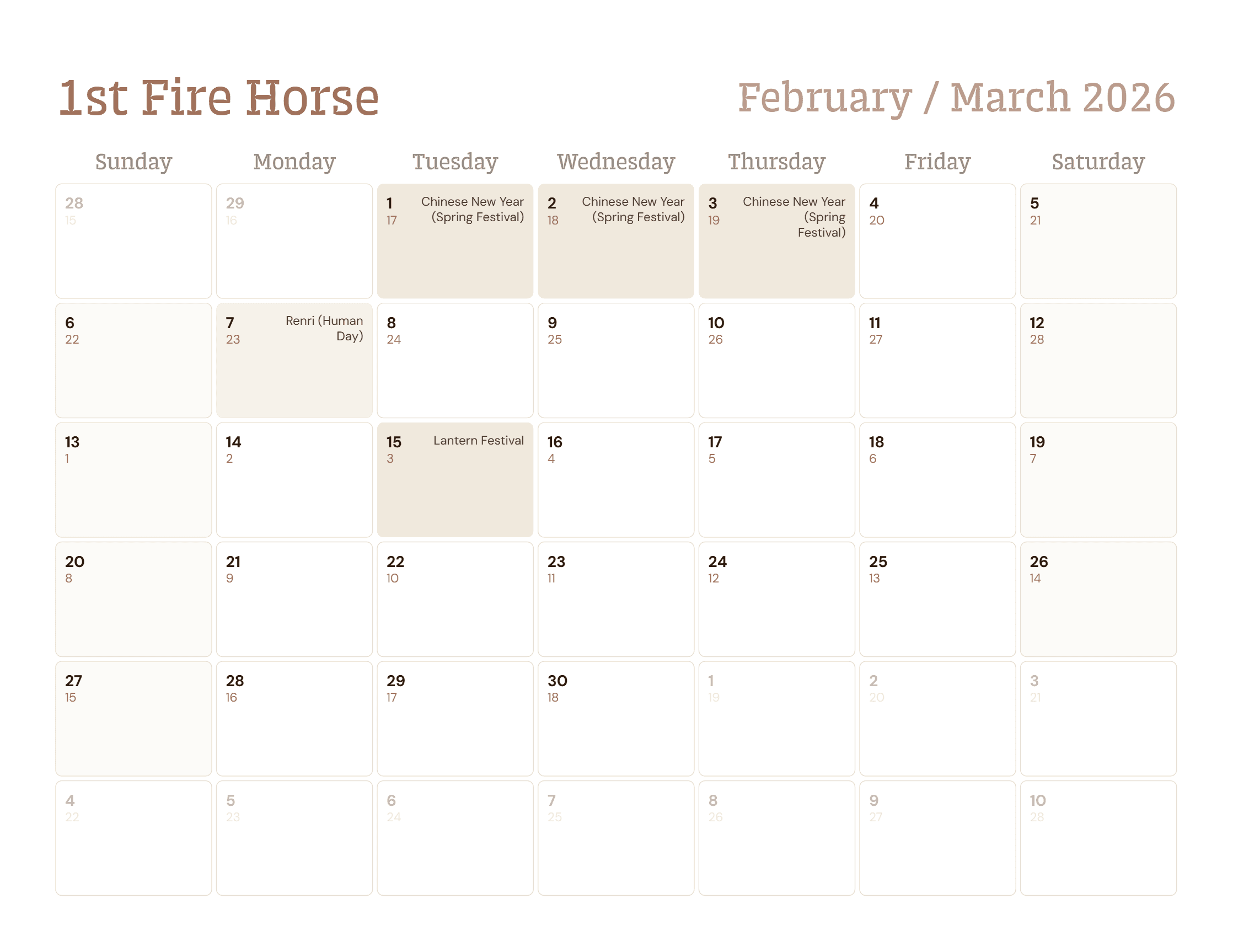
Many households keep two calendars. The traditional Chinese calendar, the nongli (农历), sets Chinese New Year, the Mid-Autumn reunion dinner, ancestors’ days, and a grandparent’s lunar birthday, while daily life runs on Gregorian dates.
A CultureSync Chinese calendar shows both in every day’s cell, with the festivals you celebrate and your family’s dates, lunar birthdays included. Customize the design and download a print-ready PDF made for the wall.
Leap months and shifting festival dates are computed for you. Most calendars are ready in minutes, and you can always come back for a fresh copy.
What’s included?
- Traditional lunar dates and Gregorian dates side by side in every day cell
- Major festivals: Chinese New Year, Lantern, Qingming, Dragon Boat, Qixi, Mid-Autumn, Double Ninth
- Zodiac year context: 2026 is the Year of the Horse (丙午)
- Personal days (birthdays, anniversaries, memorial days) entered in either date system
- Leap-month aware: lunar dates stay correct in years with an intercalary month
- US and Canadian civic holidays, if you want them
- Full customization and print-ready PDF: Letter, A4, or A3 (A1/A0 for yearly posters)
When do the major holidays fall?
春节 Chūnjié
Chinese New Year
2026: February 17, 20262027: February 6, 2027
Spring Festival. Year of the Horse begins in 2026
元宵节 Yuánxiāo Jié
Lantern Festival
2026: March 3, 20262027: February 20, 2027
15th day of the first lunar month
清明节 Qīngmíng Jié
Qingming
2026: April 5, 20262027: April 5, 2027
Tomb-Sweeping Day, a solar-term festival
端午节 Duānwǔ Jié
Dragon Boat Festival
2026: June 19, 20262027: June 9, 2027
5th day of the fifth lunar month
七夕 Qīxī
Qixi Festival
2026: August 19, 20262027: August 8, 2027
7th day of the seventh lunar month
中秋节 Zhōngqiū Jié
Mid-Autumn Festival
2026: September 25, 20262027: September 15, 2027
15th day of the eighth lunar month
重阳节 Chóngyáng Jié
Double Ninth Festival
2026: October 18, 20262027: October 8, 2027
9th day of the ninth lunar month
Festival observance varies by region and family tradition: northern and southern Chinese, Cantonese, Taiwanese, and diaspora communities each keep their own customs. Dates shown are the traditional lunar dates converted to the Gregorian calendar.
How does this calendar work?
The Chinese calendar is lunisolar: each month begins on a new moon, and a month lasts 29 or 30 days. Twelve lunar months fall about 11 days short of the solar year.
To stay aligned with the seasons, a leap month is inserted roughly every two to three years (seven times in each 19-year cycle). The next leap month falls in 2028.
Years are named in the 12-animal zodiac and the 60-year sexagenary cycle. 2026 is a Horse year (bingwu 丙午); 2027 is a Goat year (dingwei 丁未).
Want the full story? How the Chinese Calendar Works.
What do dual dates look like?
February 17, 2026
正月初一 (1st day of the 1st month)
Chinese New Year, Year of the Horse
September 25, 2026
八月十五 (15th day of the 8th month)
Mid-Autumn Festival, the full-moon festival
July 4, 2026
五月二十 (20th day of the 5th month)
Any civil date has a lunar date too
June 9, 2027
五月初五 (5th day of the 5th month)
Dragon Boat Festival
Who is it for?
Multicultural families
The reunion dinner, the mooncakes, and the school run on one kitchen calendar. The whole family reads the same month, together.
Educators
A classroom calendar that puts Chinese New Year, Mid-Autumn, and the other festivals on the school-year grid, with dates that are right every year.
Interfaith and blended households
Combine Chinese festivals with civic holidays or another tradition, so every side of the family sees their dates.
How do I create mine?
- 1
Choose your calendars
Pick this calendar (alone or side by side with others), then set your months.
- 2
Add your dates
Toggle the holidays you observe and add birthdays, anniversaries, and memorial days.
- 3
Customize and download
Pick fonts, colors, and layout, then download a print-ready PDF.
$5 during beta. No account required to start.
Frequently asked questions
Roughly every two to three years (seven times in each 19-year cycle), the Chinese calendar inserts a leap month to stay aligned with the solar year. CultureSync computes this automatically; the next leap month falls in 2028.
The major traditional festivals: Chinese New Year (Spring Festival), the Lantern Festival, Qingming, the Dragon Boat Festival, Qixi, the Mid-Autumn Festival, and the Double Ninth Festival. Each festival is an individual toggle.
Monthly layouts print on Letter, A4, or A3 paper. The year-at-a-glance layout is designed for large-format A1 or A0 posters. All PDFs are print-ready with correct margins.
Yes. Your setup is saved, so you can come back, adjust festivals, dates, or design, and re-download an updated PDF, unlimited times for a full year.
Yes. Any calendar system in CultureSync can be combined with any other. Show Chinese and Gregorian dates side by side, and add Hebrew calendar holidays and dates on the same grid.
A calendar year costs $5 during beta. Beta pricing ends this fall. Pay once, then edit and re-download as often as you like for a full year. If you do not love it, we refund every cent in your first 30 days.