
Printable Hebrew Calendar
HaLuach HaIvri (הלוח העברי)
The Jewish year and the civil year, together on one calendar your whole family reads.
Build Your Hebrew CalendarLast updated: July 7, 2026
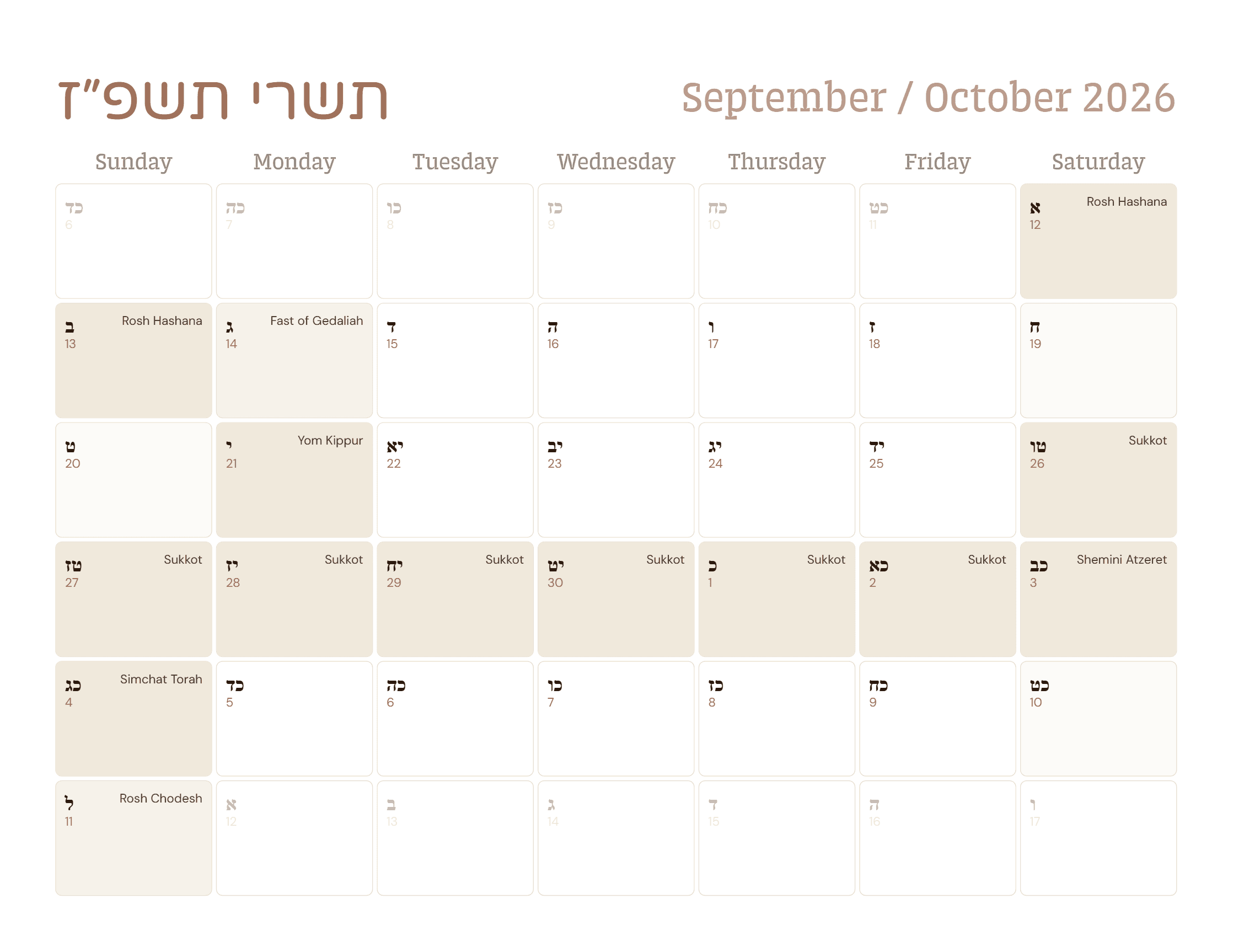
Jewish life keeps two clocks. Holidays, yahrzeits, and lifecycle events follow the Hebrew calendar (HaLuach HaIvri), while school, work, and everything else runs on Gregorian dates. Your family lives on both, and your calendar can too.
A CultureSync Hebrew calendar puts both dates in every day’s cell, with the Jewish holidays you observe and your family’s birthdays and yahrzeits in whichever date system they follow. Customize the design and download a print-ready PDF made for the wall.
Most calendars are ready in minutes, and your dates stay saved: come back anytime to adjust and download a fresh copy.
What’s included?
- Hebrew and Gregorian dates side by side in every day cell
- 40+ Jewish holidays, from Rosh Hashanah to Tisha B’Av, each one optional
- Diaspora and Israel observance: correct holiday lengths for where you live
- Personal days (birthdays, yahrzeits, anniversaries) entered in either date system
- US and Canadian civic holidays, if you want them
- Full customization: fonts, colors, monthly or year-at-a-glance layouts
- Print-ready PDF sized for Letter, A4, or A3 (A1/A0 for yearly posters)
When do the major holidays fall?
רֹאשׁ הַשָּׁנָה
Rosh Hashanah
2026: September 12-13, 20262027: October 2-3, 2027
Jewish New Year
יוֹם כִּפּוּר
Yom Kippur
2026: September 21, 20262027: October 11, 2027
Day of Atonement
סֻכּוֹת
Sukkot
2026: September 26 - October 2, 20262027: October 16-22, 2027
Festival of Tabernacles
חֲנֻכָּה
Hanukkah
2026: December 5-12, 20262027: December 25, 2027 - January 1, 2028
First candle the evening before
פּוּרִים
Purim
2026: March 3, 20262027: March 23, 2027
5787 is a leap year, so Purim falls late in 2027
פֶּסַח
Passover (Pesach)
2026: April 2-9, 20262027: April 22-29, 2027
Diaspora 8 days; Israel 7 days
שָׁבוּעוֹת
Shavuot
2026: May 22-23, 20262027: June 11-12, 2027
Diaspora 2 days; Israel 1 day
Jewish holidays begin at sundown on the evening before the first day listed. Dates shown follow diaspora observance; Israel differs for some holidays, and CultureSync handles both.
How does this calendar work?
The Hebrew calendar is lunisolar: months follow the moon, while leap months keep the year aligned with the seasons. A month lasts 29 or 30 days, and a year has 12 or 13 months.
Seven times in every 19-year cycle, a leap year adds a second month of Adar. That is why Jewish holidays drift within the Gregorian year but never leave their season.
The Jewish day begins at sundown, not midnight. CultureSync accounts for this when placing holidays and personal days on the civil grid.
Want the full story? How the Hebrew Calendar Works.
What do dual dates look like?
September 12, 2026
1 Tishrei 5787
Rosh Hashanah: the Jewish year turns
December 5, 2026
25 Kislev 5787
First day of Hanukkah
July 4, 2026
19 Tammuz 5786
Any civil date has a Hebrew date too
April 21, 2027
14 Nisan 5787
Erev Pesach: seder night
Who is it for?
Multicultural families
One calendar in the kitchen with Hebrew dates, Gregorian dates, holidays, and every family milestone. The whole family reads the same month, together.
Educators
A classroom calendar students can read: diaspora-correct holiday dates, school events, and Hebrew dates on the wall where the daily "when is that?" gets answered.
Interfaith households
Combine Jewish holidays with civic dates or another tradition, so everyone’s celebrations make it onto the fridge.
How do I create mine?
- 1
Choose your calendars
Pick this calendar (alone or side by side with others), then set your months.
- 2
Add your dates
Toggle the holidays you observe and add birthdays, anniversaries, and memorial days.
- 3
Customize and download
Pick fonts, colors, and layout, then download a print-ready PDF.
$5 during beta. No account required to start.
Frequently asked questions
Seven times in every 19-year cycle, the Hebrew calendar adds a full leap month (a second Adar) to stay aligned with the seasons. CultureSync computes this automatically: 5787 (2026-2027) is a leap year, which is why Passover 2027 falls in late April.
Over 40, including Rosh Hashanah, Yom Kippur, Sukkot, Hanukkah, Tu BiShvat, Purim, Passover, Shavuot, Tisha B’Av, fast days, Rosh Chodesh, and modern Israeli observances. Every holiday is an individual toggle. Include exactly the ones you observe.
Monthly layouts print on Letter, A4, or A3 paper. The year-at-a-glance layout is designed for large-format A1 or A0 posters. All PDFs are print-ready with correct margins.
Yes. Your setup is saved, so you can come back, adjust holidays, dates, or design, and re-download an updated PDF, unlimited times for a full year.
Yes. Any calendar system in CultureSync can be combined with any other. Show Hebrew and Gregorian dates side by side, and add Chinese calendar holidays and dates on the same grid.
A calendar year costs $5 during beta. Beta pricing ends this fall. Pay once, then edit and re-download as often as you like for a full year. If you do not love it, we refund every cent in your first 30 days.